
Citing the massive surge in Omicron infections and the resultant impact on overall economic activities in the March quarter, Swiss brokerage UBS Securities has revised downwards its India's growth forecast for the current financial year to 9.1 per cent from 9.5 per cent earlier. However, UBS Securities does not see the third wave impact extending to the next financial year as it has revised upwards its real GDP forecast to 8.2 per cent, up from 7.7 per cent earlier, expecting the real GDP growth to remain well above the historical average. The World Bank pegs it at 8.3 per cent, unchanged from its June assessment, saying the recovery is not broad-based yet.

First it was called content-led commerce. Then it came to be known as influencer-led commerce. And its latest iteration is creator economy. This evolution of the terminology for online personas impacting buying decisions -- through blogs, memes, bite-sized videos, and podcasts -- has happened over the past five to seven years.

Emerging markets such as India have always run higher inflation rates than developed economies such as the US and countries of Western Europe. But for the first time in the past 30 years, the US reported a higher consumer price inflation (CPI) rate than India in five consecutive months. The US reported a CPI rate of 7.5 per cent in January 2022 against 6.01 per cent in India and analysts expect the trend to continue for at least a few months more


Xi does not want to risk any political or economic crisis complicating his bid to remain in office, observes Ambassador Shyam Saran, the former foreign secretary.
The deficit for the first five months of the year stood at 96 per cent of the full-year target of Rs 5.46 lakh crore despite cut in capital expenditure in August.

10 stocks which are most popular with brokerages right now and are expected to deliver maximum upside over the next 12 months.
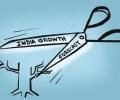
India's projected economic growth for 2022 has been downgraded by over two per cent to 4.6% by the United Nations, a decrease attributed to the ongoing war in Ukraine, with New Delhi expected to face restraints on energy access and prices, reflexes from trade sanctions, food inflation, tightening policies and financial instability, according to a UN report released on Thursday. The UN Conference on Trade and Development (UNCTAD) report downgraded its global economic growth projection for 2022 to 2.6 per cent from 3.6 per cent due to shocks from the Ukraine war and changes in macroeconomic policies that put developing countries particularly at risk. The report said while Russia will experience a deep recession this year, significant slowdowns in growth are expected in parts of Western Europe and Central, South and South-East Asia.

Is the worst over for Indian banks? The past two years saw them ride on treasury trades as deposits soared and credit growth dipped sharply. Gross and net non-performing assets (NPAs) moved south, and the provision coverage ratio (PCR), capital buffers, and profitability indicators are back at pre-pandemic levels. So, what's the plot ahead?

Chief statistician T C A Anant says growth figure might go up once indirect tax data is fully in, however, he agrees that private expenditure is yet to pick up

The real estate sector might have been caught off guard by the second wave of the Covid-19 pandemic, but large listed developers like Godrej Properties and Prestige Estates Projects soldier on undeterred. They aim to have sales bookings of Rs 10,000 crore in the next few years.

The substantially increased economic dualism may exert lasting negative influences which could include a reduced potential for economic growth; the persistence of a very weak employment and poverty situation; rising social and political discord; and heightened vulnerability to geopolitical challenges, cautions Shankar Acharya, former chief economic adviser to the Government of India.

In fact, no other recent Union Budget has held so much significance for the Indian economy as the one to be presented in about six weeks from now, notes A K Bhattacharya.

While the five years of the Modi government have indeed seen a healthy increase in PSUs' outlay and the Budgetary support for them, the next year's numbers reveal the squeeze in the government's own resources even though it is expecting a much higher dividend income from the PSUs. These do not augur well for the PSUs in 2019-20 and the years ahead, unless these numbers are revisited and, hopefully, revised in the full Budget that will be presented later in July this year, says A K Bhattacharya.

The ripples from November 8 may be seen in next year's state budgets.

The employment situation remains dire. Whatever can be done to promote greater low-skill employment should be pursued aggressively, advises former chief economic adviser Shankar Acharya.

Enhanced revenue generation is a priority for the government.

The return of private investment now struggles with lack of funds and election-driven uncertainty.

A change in the desire to buy consumer durables is perhaps the most important indicator of an economy changing direction, explains Mahesh Vyas.
The broad trends of GST collections will make you wonder if indeed the biggest indirect tax reform in the country has led to a real improvement in revenues, notes A K Bhattacharya.

'Health will continue to be at the centre of the government's attention as it underpins economic recovery and our collective well being.'

Real estate buying dropped between 2004 and 2012.

Domestic ratings agency Icra on Monday forecast a 2 per cent GDP growth in the fourth quarter of 2020-21, and a 7.3 per cent contraction for the full fiscal year. From a GVA or gross value added perspective, the agency pegs Q4 growth at 3 per cent and the full year contraction at 6.3 per cent. According to the agency, the 2 per cent projected GDP growth will help the economy avoid a double-dip recession as indicated by the National Statistical Office (NSO) for Q4. Icra's projection is better than the 8 per cent contraction forecast by the NSO as it sees Q4 growth at only 1.1 per cent.

The budget-making exercise offers golden opportunities despite challenges, observes Shankar Acharya, former chief economic adviser to the Government of India.
For a long time, the Indian economy has been drifting without a credible monetary anchor.

The 13th Finance Commission had last year set a capital expenditure-to-GDP target of 4.5 per cent by FY15.

The Indian economy is rapidly normalising towards pre-pandemic activity levels, even as uncertainty exists about coronavirus mutations and repeated infection waves, industrialist Kumar Mangalam Birla said on Wednesday. Vaccination is picking up pace, which would improve India's resilience against a potential third wave, the chairman of Aditya Birla Group said while virtually addressing shareholders at the AGM of group firm UltraTech Cement Ltd. Moreover, various steps taken by the RBI and the government have helped in containing the economic disruptions of the pandemic, Birla added.
Data shows that the PM's overseas travel bill reduced from Rs 140.14 crore to Rs 87.16 crore in the second year; data for third year is not available yet.

PM Modi on Sunday called upon states to "speed up capital expenditure and infrastructure creation" to spur economic growth.

No new capacity addition is planned for 2018 and capital expenditure plans are on hold

'Even before the outbreak of the flu, it had become clear that the tax revenue numbers for 2019-2020 were overestimated,' observes A K Bhattacharya.
The plea said there should be a total ban on such populist measures to gain undue political favour from voters as they violate the Constitution and the ECI should take suitable deterrent measures.
Despite a slowing economy, the Budget does not envisage any major stimulus through the budgeted fiscal deficit figures, said Goldman Sachs.

The bank is using readily available satellite images from ISRO and NASA for the purpose, and plans to scale up to 63,000 villages in the next three months.

'As valuations of large-caps appeared to be out of whack, investors started lapping up quality mid-caps and small-caps, which were available at relatively comfortable valuations.'
Despite warnings from a parliamentary panel, the list of tax exemptions in 2012-13 shows a rising trend.

"Numerous rounds of talks have taken place with the Chinese counterparts to deescalate the situation without compromising on India's stand of 'complete disengagement and immediate restoration of status quo ante'," the defence ministry said.

The remarkable feature of those reforms unveiled in 1991 is that none of those decisions has been disowned by subsequent governments in the last 25 years.

The Tata Sons' chief said that world's reliance on China for sourcing goods will reduce, and India will definitely have an opportunity to participate.

Fitch Solutions sees RBI keeping benchmark interest rates unchanged during the fiscal to March 2022 following its decision to buy Rs 1 lakh crore of government bonds. "We had initially expected another policy rate cut to arrest the rise in government bond yields since the Union Budget announcement in February. "However, having an explicit bond purchase guidance from the RBI following the announcement of the G-SAP will also achieve a similar effect, if not even be more effective than a rate cut on capping the increase in bond yields," it said in a note. The Reserve Bank of India (RBI) held its policy repurchase (repo) rate unchanged at 4 per cent at its monetary policy meeting on April 7.
